Short-term forecasting of oceanic currents with generative models
Accurate prediction of ocean surface currents is critical for oil spill response, search-and-rescue and maritime safety operations. Traditional oceanographic models often lack the spatial and temporal resolution needed for real-time decision-making. We investigated whether such forecasts can be learned from two-dimensional observations alone, without access to the full three-dimensional ocean state — using daily surface currents from the GLORYS12 reanalysis and 10-metre winds from ERA5 as the only inputs, on a regional domain covering the Agulhas current south of Africa.
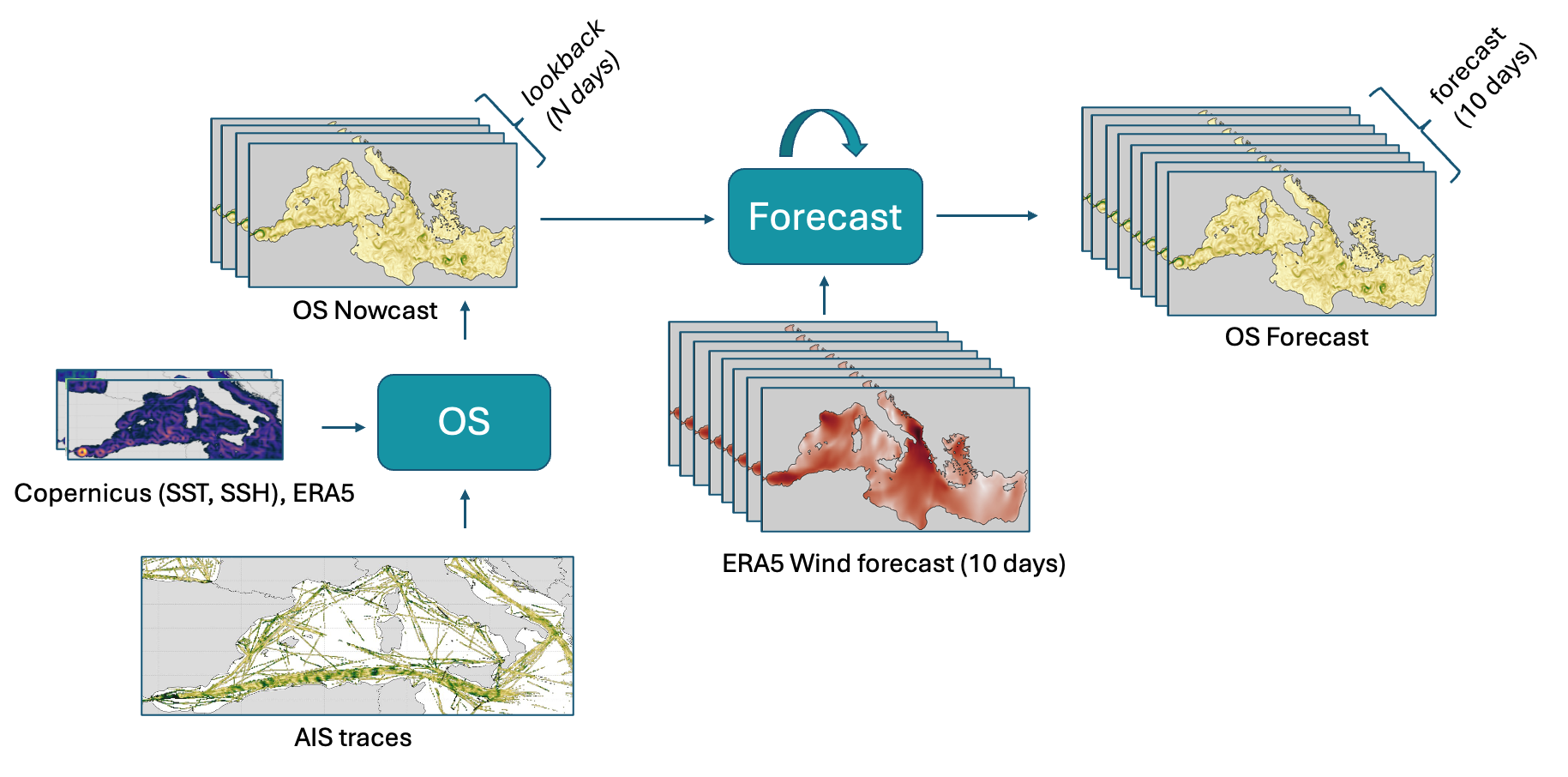
We trained and compared three neural architectures: a U-Net, a Swin Transformer, and a flow matching generative model. All three produce 10-day forecasts of similar accuracy, reaching a root mean square error of approximately 16 cm/s at day 10. This suggests that forecast skill is limited by the intrinsic predictability of mesoscale ocean dynamics at this resolution, rather than by the choice of architecture.
The flow matching model additionally produces an ensemble of physically plausible forecast trajectories, from which spatially coherent uncertainty estimates can be derived at no extra modelling cost — a crucial capability for operational applications, where understanding prediction confidence guides critical decisions. Inference with a single Euler step and a lookback of only two days is sufficient for near-optimal performance, making the approach well suited for operational deployment.
→ Preprint: From data to currents: generative models for short-term forecasting of oceanic currents (Vitay, Guichoux & Jan).